Level Design
Throughout my career, I've shipped multiple levels in different genres from traditional 3D arenas to more strategic map design. My approach to level design is grounded in a gameplay-first mentality, supported by a strong emphasis on player agency and storytelling.
◆
Multiplayer Arena Design


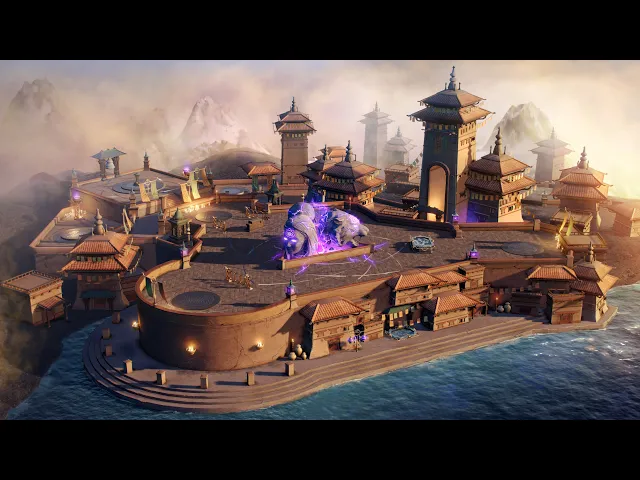
I was the level designer on 4 main Maps: Kamar-Taj (PvE), Palladium Mines (PvP), The Raft (PvP), and Asgardia (PvP). With each level, my focus was on providing small "home court" advantages to each level's Champion:
The Palladium Mines provides highly protected ranged opportunities for Iron Legionnaires to poke the center from the outside lane, and make quick exits to safety if the single open lane next to them is threatened. It also provides an easy choke point for their allies to defend them, reducing risk further.
The Raft provides a deadly kill box in the middle, with high cover offering 180° total of area for The Civil Warrior's shield throw to ricochet, causing massive damage. The cover position in the center also provides Civil Warrior with more protection as a melee character when they charge the capture point.
For Kamar-Taj, my approach was heavily choke and low-cover oriented. Kamar-Taj features more low cover on the outside edges of either side, and more towards the center of the map (where enemies spawn). It has more high cover and choke points closer to player spawns (where the AI enemies are likely to flow). This means aggressive Dr. Strange play styles can push further out from spawn and pick off mobs, but retreat to take advantage of chokes closer to their back line. A more conservative Dr. Strange can hang out around the edges to mitigate mobs flanking their allies and more easily heal them.
◆
Level Design Preproduction
During Pre-production of Realm of Champions, I worked with our Creative Director and Quest Lead to define the vision for Quests and Levels, while also contributing to the design of multiple Game Modes such as our flasgship “Baron Wars” mode.
In this 2019 Prototype, you can see the early explorations for Quests and Levels. These early experiments focused on delivering handcrafted levels and encounters across “node” maps to give players a sense of progression. Over time, we pivoted to a more repeatable mode-based structure to support higher quality content and visual fidelity.
◆
Level Design Pipeline


Later in Realm's development, our vision evolved to include dozens of PvE and PvP Mode Archetypes - we estimated we would need hundreds of levels to meet the demand of our gameplay variety ambitions. Our level pipeline quickly showed it was not ready for production at scale and I was tasked with working with gameplay and rendering engineers to build a modular level system that would:
Shrink the delta in quality across our supported devices by allowing more pre-rendering.
Speed up level creation and iteration time.
Retain level design flexibility.
Support “pallette swaps” for different environments to multiply perceived environmental variety.
We ended up with an extremely robust system that, while meeting the above goals, would no longer have suited the metagame structure focused around a much less varied set of modes. Thus, it was abandoned for a more traditional level design pipeline with fewer overall levels.